Sam Katz
Documentary Filmmaker
HistoryMakingProductions.com
Sam Katz is a longtime Philadelphia businessman, politician and civic entrepreneur. After decades working in municipal finance and three runs for Mayor, Sam Katz is leading a team (History Making Productions) that is producing a history documentary of Philadelphia. Mr. Katz is also engaged in several other Philadelphia related ventures such as trying to make Philadelphia the centerpiece of the country’s 250-year celebration in 2026.
Philadelphia: The Great Experiment is a multi-format historical documentary television, film and Internet project that presents the story of Philadelphia, the single most compelling stage for the unfurling and testing of American ideals.
William Penn’s city was the first in the world to codify freedom of religion, individual rights, trial by jury, and a democratic assembly as the pillars of a constitution amendable by the people. Since then, ideas of equality and tolerance, public good and private enterprise, freedom and subjugation, have been continuously measured against each other and Penn’s own vision.
A primary goal of the film is to give the viewer a better understanding of the origins and development of American ideas and ideals and the American character, through the lens of the Great Experiment. The story of democracy, the Constitution, civil rights, religious freedom, and of pluralism originates in Philadelphia. By using Philadelphia as an outstanding example of the urban crucible, viewers will not only understand Philadelphia better, but will appreciate the meaning of being American more fully.
The aim of the film project is to create a dozen feature episodes (six hours’ total). Each feature episode is further supported by "Webisodes" (stand-alone films that highlight a specific topic), “Lens through Time” features (oral histories with music and images of 20th century topics and people), “Short Cuts” (short interviews with scholars, witnesses, historians and authors) and “Images” (selected photographs and paintings). There are also DVD versions of the episodes and there may be a book. Combined, the episodes will span four centuries from William Penn’s founding of the city through the present. Katz hopes to complete the project by 2015.
What inspired you to want to create a film about Philadelphia?
It was a convergence of forces. I have a great passion for the city. I grew up in Wynnefield, rooting for the St. Joe's Hawks. I’ve lived here most of my life, went to public schools in the city, and love all aspects of city life.
Politically, I was inspired by Richardson Dilworth (Philadelphia’s Mayor from 1955 through 1962) and John Kennedy, whom I heard speak when he ran for President. My own political losses were a wake-up call to try to learn more about the city.
My life strategy was to work in business for 20 years, public service for 10, and then teach or do something after public life. The business phase lasted for 30-35 years. After my political defeats, I started to think about the academic phase.
I happened to watch the film Gangs of New York, by Martin Scorsese. There was a scene in the film that fascinated me. A house was on fire. A volunteer company led by Boss Tweed (William Magear Tweed) arrived. A second volunteer company also arrived. Instead of combining forces to put the fire out more quickly, the rival companies fought each other over who would have the right to put out the fire. Meanwhile, the house burned. There were other issues in the film, such as New York’s draft riots during the Civil War, that made me want to investigate the real history behind the stories that were presented.
I began by reading Gotham, a history of New York by Mike Wallace (a professor at New York’s John Jay University). Wallace was the advisor to the Ric Burns film series on New York. I watched all seven episodes of Burns’ New York series and an eighth on the World Trade Center.
In 2005, I began to look at documentaries (mostly less sweeping than New York) on other cities. I found documentaries on Chicago, Las Vegas, New Orleans, Milwaukee, and Miami. What I was surprised to find was that there wasn’t a documentary on Philadelphia. I also spoke with Donald L. Miller (Lafayette College), who wrote about Chicago. Miller’s City of the Century: The Epic of Chicago and the Making of America was made into a three-hour documentary film series for PBS’s The American Experience.
Unlike Mike Wallace’s New York and Donald L. Miller’s Chicago, Philadelphia didn’t really have a single historian who knew all the ins and outs of Philadelphia. The book Philadelphia: A 300-Year History, edited by Russell F. Weigley, contained contributions from a variety of specialists who each cover their period of expertise. It lacked a single consistent voice.
With these forces and ideas, I decided that instead of teaching or going back to school myself, creating a history documentary would be my PhD. When I mentioned to my wife the worry that people might say that I’m not a historian and I don’t know what I’m doing, she replied: “How is that different than politics?”
No city has more to tell America about history than Philadelphia.”
Who do you hope to reach with the film?
I’d like to reach everyone. I think Philadelphia is a model for other cities in the US and around the globe.
I’m trying to reach people of all ages, especially younger audiences. The feature film episodes are designed to fit into a typical classroom schedule so that the films (about 26 minutes) can be shown and also discussed in one class session. A major reason we're including Webisodes, the Lens through Time feature, and Short Cuts (personal interviews) is to encourage students to go beyond the film and learn more about the topics that interest them. I was very pleased that our second episode on Yellow Fever was a resource for students and teachers who were learning about Yellow Fever in the classroom by reading Laurie Halse Anderson’s Fever 1793 and other books on the epidemic. The Yellow Fever epidemic killed 10 percent of the city’s population of about 50,000 in 1793 and another 5,000 in subsequent years.
Why are you doing the segments in a non-chronological order?
Most people’s view of Philadelphia is 1776-centric. But Philadelphia has had a wonderful life since then. It’s really a 19th-century city in the sense that the 19th century has most defined its physical and cultural development. So, I wanted to start with a decade other than the one most people already knew. I liked the period right after the Civil War. That’s when there was a drive to build the nation’s tallest building (at that time) – City Hall, to develop Wissahickon and Fairmount Parks, and to create the nation’s Centennial Exhibition in 1876.
Plus, it’s an expensive project. I wasn’t sure how much money I could raise. The whole project runs about $800,000 per hour of film. That’s still a continuing effort. So, I thought if I could only do one episode, that the decade after the Civil War would be the one. The episodes that I’ve completed (as of the date of this interview) are:
1600–1680: A Lost World
1680-1720: In Penn’s Shadow
1720:1765: Franklin’s Spark
1765:1790: The Storm
1790:1820: Fever
1820:1854: Disorder
1855-1871: An Equal Chance
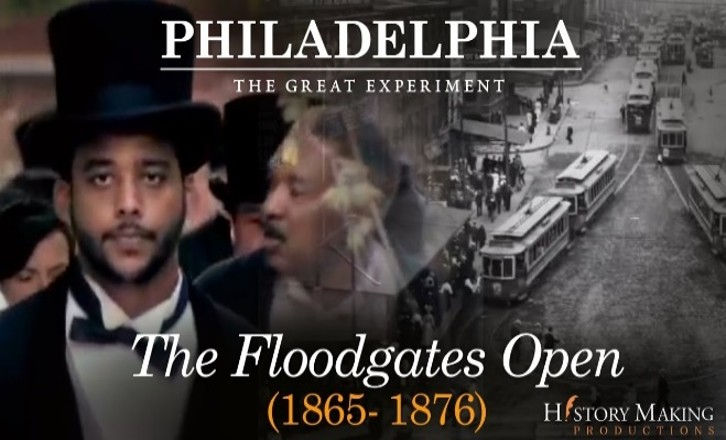
1865-1876: The Floodgates Open
1944-1964: Promise for a Better City
1965-1978: The Fight
1978-1994: Breakthrough


What have you learned about Philadelphia’s character since you started the film that you didn’t know before you began?
For starters, Philadelphia is itself a city of characters. Throughout its rich history, it’s had reformers, aspiring capitalists, women with a strong moral vision, and many more interesting types. These characters seem to recur with each new generation.
It’s also had an unfortunate negative reputation to go along with all the wonderful things it has created. The negativity comes from a variety of sources:
-
The Yellow Fever epidemic
-
The loss of Philadelphia as the Nation’s and the State’s Capitol
-
The building of the Erie Canal. We tried to build a canal across Pennsylvania, but ran into the Allegheny Mountains, which proved insurmountable.
-
The loss of banking as the Nation’s financial center when President Andrew Jackson failed to renew the charter for the Second Bank of the United States
-
We were known as the “Athens of America” and the “Workshop to the World.” With time, Philadelphia’s national industries have left. Even local industries have been problematic. Once, we were known for our proximity to coal (which helped create the railroads). Later, people became concerned about coal’s effects on our air.
Philadelphia also has a reputation for being contented, for not dreaming big. The Quakers were well known for not wanting to boast.
Its ethnic neighborhoods (often a source of joy and creativity) have also been a source of toughness and even violence. Philadelphia, though, does also have a reputation, I’ve noticed, for getting knocked down and getting back up. Joe Frazier and Rocky are classic boxing examples. But there are other examples inside and outside of sports.
As you noted, Philadelphia has had several transitions from the Cradle of Liberty to the Biddle Age to the Workshop of the World to the Age of Reform under Richardson Dilworth and Joe Clark. What’s the next great transition for Philadelphia?
Now, Philadelphia’s emphasis is on its wonderful cultural assets – art, food, music, dance, etc. The Philadelphia Museum of Art, the Barnes Foundation, the Pennsylvania Academy of the Fine Arts, and other arts, for example, are part of the city’s Miracle Mile.
If there’s to be a “New” Philadelphia, I hope that Philadelphia will be an international city. I hope, through this film and other projects, the city can have an “international” brand. I’m helping Philadelphia’s effort (through my chairmanship of USA250) to be the host of the Nation’s 250th year celebration in 2026. USA250 wants to promote events based on six pillars.
1. Democracy and Citizenship.
2. Metropolitan Sustainability.
3. Creative Spirit. Arts and Culture.
4. Competition, Teamwork, and Sportsmanship.
5. Human Capital Investment.
6. Entrepreneurship and Innovation.
Philadelphia has had different tensions throughout its life. The heart of Penn vs. the mind of Franklin. Green country town vs. a city. Race and religion. Neighborhoods vs. the city as a whole. You’ve commented elsewhere on competition vs. collaboration. How do you incorporate those tensions in your film?
Yes, all of those tensions have made up the fabric of the city. We try to emphasize storytelling in my feature episodes. I’m conscious that in the 21st century, people watch television with a remote control and with a smartphone. If we lose their interest, even for a second, the viewer will move elsewhere. The tensions are the stories that we try to capture. They’re what make the stories exciting.
What is the long-range plan for the series?
We’ll have a full set of episodes, webisodes, shortcuts, and educational resources. Our principal outreach from that point forward will be digital. We have a very aggressive initiative to embed the website history of Philly into other websites. We sometimes call it the Philadelphia History Channel.
Amy Cohen, our educational director, is constantly reaching out to teachers and conducting professional training on how to use media in the classroom. We will continue to do community screenings, which will enable us to have the entire history of Philadelphia available for whichever subjects or time frames audiences in different parts of the region may be interested in.
Chronologically, the aim is to cover 1600 to 1995. What’s left is 1871 to 1944. There are three episodes left. I don’t think we’ll try to do anything to try to change it. We will put on a DVD box set. We will probably sell it. It will be online at no cost. Sets will show up in retail stores and online.
You’re working on advisory panels to work with the community and to focus on educational outreach. Can you say more about those panels? What are the panels? What people are on them?
As I mentioned, I’m not an expert, and I don’t know of any experts on Philadelphia’s history like Mike Wallace’s New York, Donald L. Miller’s Chicago, or Kenneth Jackson (a professor at Columbia University who edited The Encyclopedia of New York City).
So, for each episode, we're trying to get input from a variety of sources. Historians, but also journalists, authors, and people directly knowledgeable about the topics. We include many video interviews of those with direct knowledge in my project. For example, when I talked to Donald L. Miller, he asked me what’s the most important piece of real estate in New York? I suggested the Empire State Building. Miller said the most important real estate in New York was the burying of the railroad tracks that made possible midtown Manhattan.
He also suggested that, in New York’s history, the most notable profession wasn’t finance nor the arts – it was crime. The point he was making was not to have preconceived ideas. If we are going to work on a history of Philadelphia, we should let the facts fall where they may. That’s what we try to do with my advisors.


How did your other experiences (a former mayoral candidate and your work in finance) impact your film-making venture?
2 Pluses. 2 Minuses. People know me, so they’ll take my calls. They also know I’m passionate about the city – that I want the city to succeed.
But people wonder whether a politician can also be an historian. And many people think – well, he’s good at raising money, so he can get it from other people. Unfortunately, I started this project just when the economy turned sour. I do need lots of help raising funds. The project is supported by the Historical Society of Pennsylvania, a 501(c) 3 non-profit. I do welcome and need all the financial help I can get.
What’s been the reception to your Philadelphia film venture so far? Where do you think you can improve?
Jim Gardner, the city’s longest-tenured anchor at ABC, the city’s most-watched station, is showing each episode commercial-free. The media (Philadelphia Inquirer, Philadelphia Daily News, Philadelphia Tribune, and the City Paper) have had supporting editorials, and their TV and film critics have written favorable columns. I’m also showing the films to a variety of civic groups.
Many of the city’s cultural and civic sites also include links to the project on their sites. The Historical Society of Pennsylvania, the free libraries, and various museums, to name a few.
My son, Phil, created a video content management system to make the selection of the video content easy. I hope that the project will be a virtual museum for the city.
I try to get as much feedback (from teachers, civic groups, and others) as I can on each episode, which is one reason I don’t rush through the episodes. I’m still trying to learn and do a better job with social media. We’ve been honored to win many local Emmy Awards.
Why did you create the series on Catholic Philadelphia called The Urban Trinity?
At one time, Philadelphia was a Catholic city; it was 40% Catholic. The influence of immigrants, Catholicism being a common denominator, was pretty evident in our other work. At one time, Philadelphia was a Quaker city, but that didn’t last very long.
We wanted to look at Philadelphia through a different lens; the Catholic world seemed to be a good one, and timely since the World Meeting of Families was taking place in September. 2016. Catholic Philadelphia is defined through parishes, Catholic schools, and political influence – much of what the city is. We really, I think, excavated some pretty interesting aspects of the city’s story through that lens. I was very happy with that, as many people were.
What other Philadelphia film projects are you doing?
We have a project called The Daring Women of Philadelphia. Obviously, about women, and focusing initially on the period 1800 – 1848. That’s when temperance, moral rectitude,
Abolitionism, earlies stage of women’s suffrage all kind of combined in a combustible manner in Philadelphia. Some very impressive, quite daring women broke out of traditional roles considered sensible to and for women.
Symphonic Revolution. China and the Future of Classical Music is another project. It’s not Philadelphia-centric but obviously Philadelphia-connected. It’s based on the story of how the Philadelphia Orchestra, beginning in 1973, brought classical music back to China during the Cultural Revolution and how the arc of audience enthusiasm has risen dramatically in China and declined dramatically in the US.
The question now is what the future of classical music is, and how China and the Philadelphia Orchestra help answer that question.
Speed of Light. Philadelphia and the Birth of Motion Pictures is one more project. It’s very different than anything we’ve done. It’s about technological advancements made by Philadelphia innovators that helped transform still photography and build the motion picture industry.
Siegmund Lubin is a central character. So is Garret Brown, who invented the Steadicam. Henry Heyl, Charles Willson Peale. Thomas Eakins. There are a lot of interesting characters, including William Sellers, all of whom did things that moved the needle towards what became movies. There are the theater magnates Julius Mastbaum and William Fox. The Colored Players Film Corporation produced films.


